Torchlight (2009), revisited: small, focused and still charming
The first Torchlight was built by a small team in under a year. Seventeen years later, its simplicity has become its biggest virtue.
In 2009, a small studio in Seattle called Runic Games, founded by veterans of Blizzard North and the team behind Fate, released a modestly priced action RPG. Torchlight had no open world, no multiplayer and no grand ambitions. It just wanted you to go down a mine, hit things and pick up loot.
It did it extremely well. Torchlight was a critical and commercial success, launched a series and helped prove that a small, focused team could compete with the giants of the genre. Seventeen years later, we went back down the mine to see how it holds up.
A studio with a pedigree
To understand Torchlight, it helps to know who made it. Runic’s founders included people who had worked on the Diablo games at Blizzard North, and people who had created Fate, a smaller, charming action RPG with a pet companion and a single, deep dungeon.
Torchlight combined those two lineages: the satisfying click-and-loot rhythm of Diablo and the approachable, colourful style of Fate. It was developed quickly and on a modest budget, and it shows in its focus. There’s nothing here that doesn’t need to be.
The descent
The structure couldn’t be simpler. You arrive in the mining town of Torchlight, a cosy settlement built on top of rich deposits of Ember, a magical mineral with the unfortunate habit of corrupting those who use it. Something has gone very wrong in the mines below, and the town needs a hero.
You go down, floor by floor, through mines, dwarven ruins, crypts, ancient temples and stranger places, returning to town to sell, upgrade and set off again. Each floor is randomly generated from hand-crafted pieces, so no two runs are identical.
That linearity, which looked limited at the time, is refreshing today. There are no maps full of icons, no checklists of activities, no seasonal events. Just one more floor, and then another.
Three classes
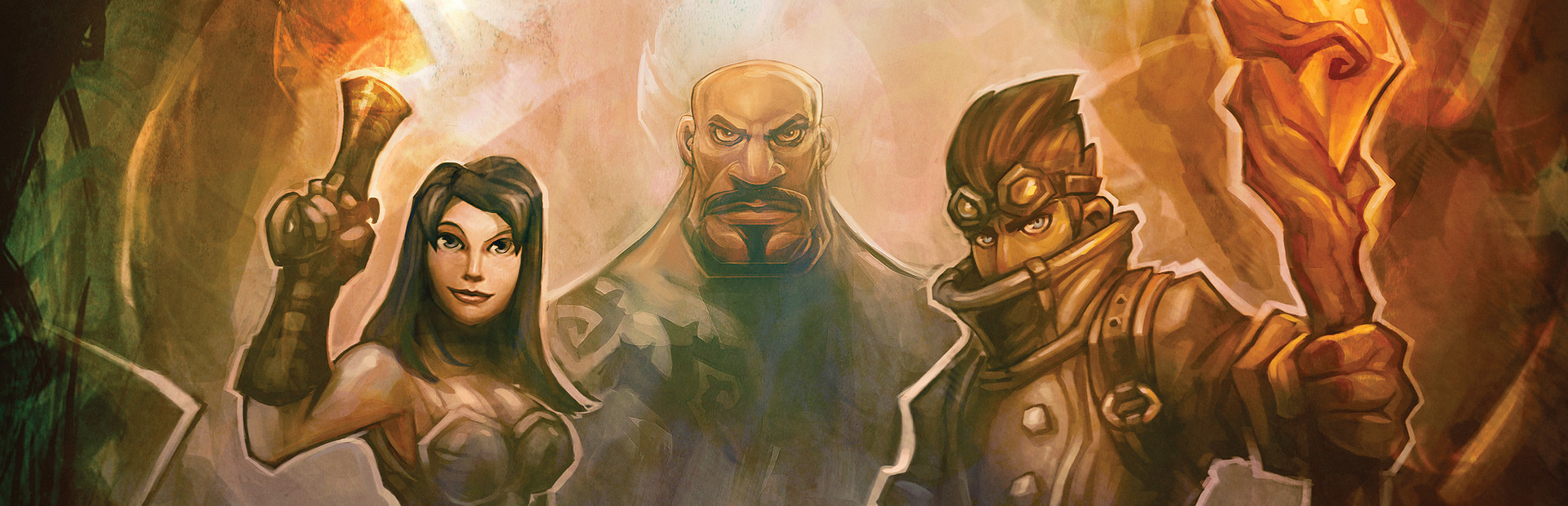
You choose between three heroes:
- Destroyer: a melee warrior, built for getting into the thick of the fight with big weapons.
- Vanquisher: a ranged fighter specialising in bows, crossbows and guns, with traps and tricks.
- Alchemist: a spellcaster who uses Ember magic, summons minions and blasts enemies from a distance.
Each has three skill trees, offering a reasonable range of builds. The system isn’t as deep as the genre’s leaders, and some skills are clearly better than others, but it’s easy to understand and satisfying to develop.
The pet
The real star is your pet — at launch a dog or a cat, with a ferret added later — that fights by your side.
It’s not just a companion. Crucially, it can run back to town to sell your junk while you keep exploring. When your bags are full, you send the pet off, and a minute later it returns with gold. It’s such an obviously good idea that it’s surprising how rarely the genre copies it.
Pets also have their own inventory, can equip some items and can learn spells. And by feeding them fish caught in fishing holes throughout the dungeon, you can temporarily transform them into other creatures, from spiders to trolls. It’s a lovely touch that adds variety and personality.
Loot and enchanting
Like any good action RPG, Torchlight is built around loot. Enemies drop weapons and armour of different rarities, with random properties, and finding a powerful item is genuinely satisfying.
Beyond that, you can:
- Enchant items in town, adding random properties at a cost — with a risk of losing everything if you push your luck.
- Socket gems into items for extra bonuses.
- Collect sets of matching items for additional effects.
Retirement and endless dungeons
Once you finish the story, the game offers more:
- An endless dungeon, with randomly generated floors, for players who want to keep levelling.
- Retirement: you can retire a character, passing an heirloom item to a new hero. It’s an early form of the “legacy” systems later seen in other games.
The art style
Runic chose a colourful, slightly cartoonish style, with exaggerated proportions and warm lighting. It has aged far better than the realistic graphics of many of its contemporaries. The environments are varied and atmospheric, and the music, by Matt Uelmen — who also composed for Diablo — is excellent.
It also runs on practically anything, which makes it a good choice for older or low-powered computers.
Mods
Torchlight included TorchED, an editor that allowed players to create mods. The community produced new classes, items, dungeons and tweaks, though the modding scene was much bigger for the sequel.
What has aged worse
- No multiplayer, which was the most common complaint at launch and was addressed by the sequel.
- Combat can become repetitive in long sessions, given the linear structure and limited enemy variety.
- The story is barely there: a few cutscenes, a handful of characters and a predictable villain.
- Balance: some skills and builds are far stronger than others.
- Interface: functional, but a bit dated.
How it compares to its sequel
Torchlight II (2012) expanded on everything: open zones, four new classes, co-op multiplayer and a much stronger modding scene. It’s the better game overall, and we recommend it as the starting point for the series in our guide Torchlight 1, 2 and 3: which one should you start with today?.
But the first game has its own appeal: it’s shorter, simpler and more focused, and it’s a great introduction to the genre for players who find bigger games overwhelming.
Verdict
Torchlight is not the best game in the series. But it’s a compact, polished and generous little action RPG that respects your time. Its art style, its pet and its “one more floor” rhythm still work today.
Perfect for a few evenings, as an introduction to the genre, or as a way to see where one of the most charming series in action RPGs began.