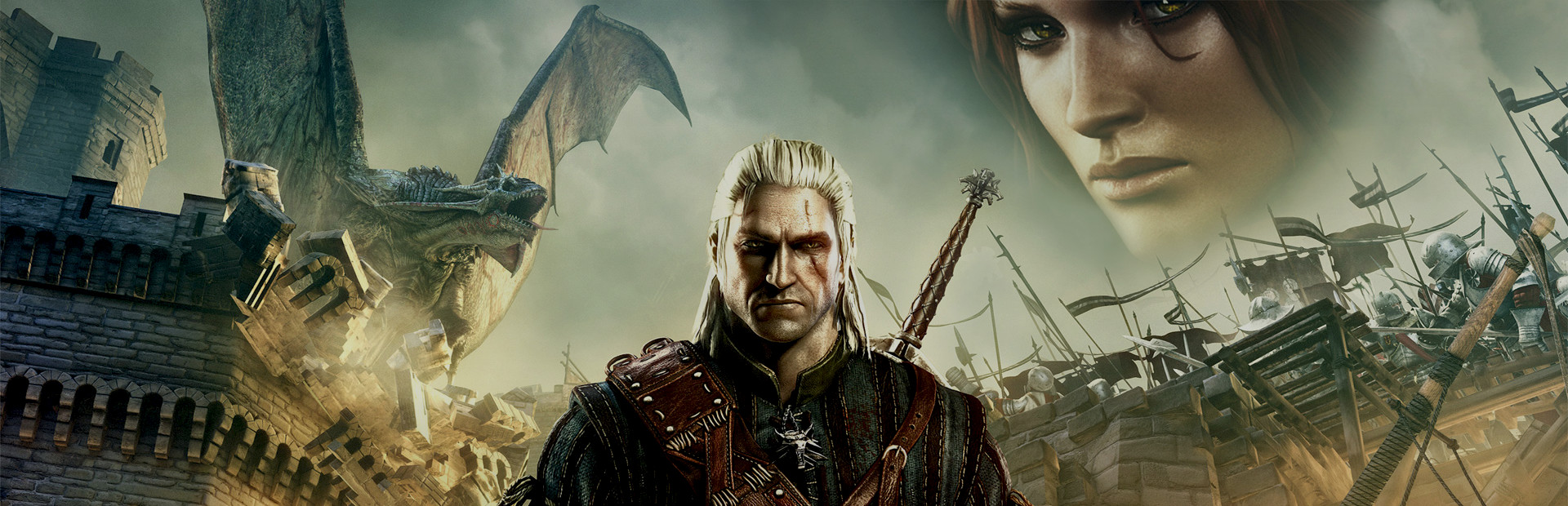
The Witcher 2: the most underrated chapter
A story that truly branches in its second act.
Between the handcrafted charm of the first The Witcher and the monumental scale of the third, Assassins of Kings often ends up in no man’s land. Players who started with Wild Hunt frequently skip it; players who loved the first game sometimes remember it as the one where combat got frustrating. That’s unfair. Revisited today, The Witcher 2 may well be the bravest game in the trilogy — and the one whose ideas are still most rarely copied.
The setup
The game opens shortly after the events of the first. Geralt is serving as a bodyguard to King Foltest of Temeria when the king is assassinated in front of him by a mysterious killer — a man who, Geralt soon discovers, is also a witcher. Accused of the murder, Geralt must clear his name by hunting down the real assassin, Letho of Gulet.
What begins as a manhunt quickly becomes something much bigger. Several kings have been killed by the same group of witchers, and the northern kingdoms are destabilising. Sorceresses scheme, armies march, elven rebels fight for survival and a powerful southern empire watches and waits. Geralt is a pawn in a game played by far more powerful forces.
A daunting start
Let’s admit it: the first few hours are tough. The prologue, framed as an interrogation in which Geralt recounts recent events, throws you into the siege of La Valette castle with demanding combat and a minimal tutorial. Enemies hit hard, Geralt is fragile, and the controls take time to master.
Many players quit right there. If you hold on until Flotsam, a river town on the edge of a forest, the game opens up and starts to click. You learn when to roll, when to block, when to use Signs and how to prepare with potions and bombs.
A few tips for the opening hours:
- Use Quen: the shield Sign absorbs damage and is invaluable early on.
- Roll, don’t block: rolling out of the way is usually safer than blocking.
- Fight in doorways: avoid being surrounded; funnel enemies.
- Drink potions before fights: you can’t drink them in combat, so prepare in advance.
- Lower the difficulty if you need to. The story is worth it.
The choice that changes everything
At the end of the first act, Geralt must choose between helping Vernon Roche, commander of the Blue Stripes, Temeria’s special forces, or Iorveth, the charismatic leader of a band of Scoia’tael elven rebels. Both have good reasons; both have blood on their hands.
It’s not a dialogue choice with a cosmetic consequence: the entire second act is different.
Iorveth’s path
With Iorveth, Geralt travels to Vergen, a free town of dwarves, elves and humans led by Saskia the Dragonslayer, a charismatic leader who has rallied people of all races. You experience the war from inside the besieged town, with its own quests, characters and revelations.
Roche’s path
With Roche, Geralt joins the camp of King Henselt of Kaedwen, whose army is besieging Vergen. You experience the conflict from the other side, among soldiers, nobles and their own intrigues.
Locations, quests, characters and revelations all change. Some characters only appear on one path; some mysteries are only resolved on one. To see the whole story, you need two playthroughs — and both are worth it.
This is something almost no studio has dared to do since. Building an entire act that half of your players will never see is expensive and risky. CD Projekt did it anyway, and the result is a game whose world feels genuinely shaped by your decisions.
Politics over epic
The Witcher 2 is the most political chapter of the series. Its story is about:
- Murdered kings and the power vacuums they leave behind.
- Scheming sorceresses, whose lodge pursues its own agenda behind the scenes.
- Racial conflict, with non-humans persecuted and fighting back.
- Imperial ambition, as a southern empire plots its next move.
At the centre of it all is Letho of Gulet, one of the most interesting antagonists in the series. He’s not a cackling villain but a professional with his own logic, debts and loyalties. When you finally understand his motives, the story takes on a new dimension.
There’s no absolute evil to defeat, just a board of competing interests where Geralt is one more piece. The game trusts you to understand the politics and to make choices without a clear right answer.
The world
The game is divided into a prologue, three acts and an epilogue, each set in a contained region rather than an open world. This structure allows a density that the third game, for all its scale, doesn’t always match:
- Flotsam and its surrounding forest, home to smugglers, rebels and monsters.
- Vergen or Henselt’s camp, depending on your choice, and the surrounding battlefields haunted by curses.
- Loc Muinne, an ancient elven city where kings and sorcerers gather for a fateful summit.
Every side quest feels connected to the political tension around it. Even monster hunts often have consequences for the larger story.
Combat and systems
The combat is more active than in the first game: Geralt can attack quickly or strongly, roll, block, parry and cast Signs. It’s demanding, especially at first, but rewarding once mastered.
Character progression is divided into skill trees: training, swordsmanship, alchemy and magic. Alchemy is important for potions and bombs, while magic strengthens Signs. Crafting allows you to create gear from recipes and materials.
There’s also arm wrestling, fist fighting and dice poker as side activities, a precursor to the third game’s Gwent.
How to play it today
The 2012 Enhanced Edition added content, improved the tutorial and polished the combat. It’s the definitive version, and it’s the one you’ll find on digital stores.
- On PC, it still looks great, with sharp textures and atmospheric lighting.
- On Xbox, it remains playable through backward compatibility.
If you’re coming from Wild Hunt, expect a more linear, focused experience, with a steeper difficulty curve at the start.
What has aged worse
- The opening hours, which can push players away.
- Some interface elements, especially inventory management.
- The third act, which is shorter and more rushed than the first two.
- The ending, which leaves several threads open for the sequel.
Verdict
The Witcher 2 is shorter than Wild Hunt, and its combat asks for patience early on. But its commitment to real branching is still rare even today, its political story is the most intricate of the trilogy, and its focused structure gives every location weight.
If you skipped straight to the third game, go back. You’re missing a key piece of Geralt’s story — and one of the boldest RPGs of its generation. For the bigger picture, read our trilogy retrospective.